

Life Before Petroleum
Yes, petroleum is bad, but...

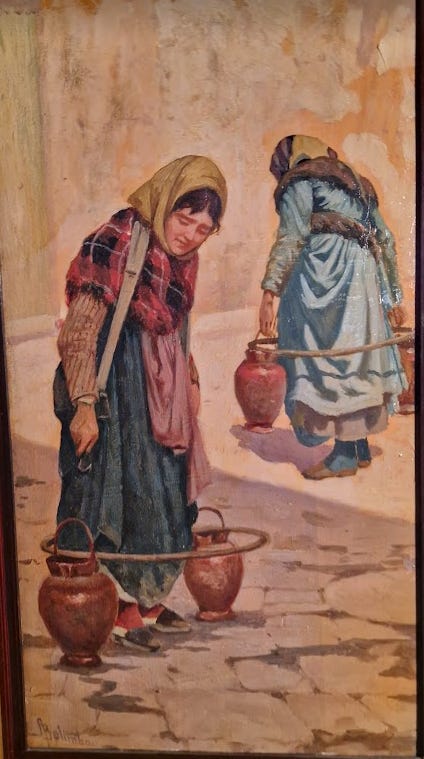
Image courtesy of Grazia Maccarone
This is a painting by the Italian artist Adolfo Belinbau (1845 –1938). Born in Cairo, Belinbau is considered a minor painter, but he shared much of the artistic currents of his age and his paintings are a precious record of his age in Europe and in the Southern Mediterranean region. This one, probably painted in the late 19th century, is remarkable for a detail: the large ring that the women use to carry the water jars. The idea is that the ring keeps the jars at a certain distance, avoiding that they would bump into the person’s legs. The recipients in copper were called mezzine in Italian. The ring may have been called “cerchio.” I couldn’t find evidence that it was commonly used in Italy, but surely it existed in North Africa and the Middle East, where the ring was called "halqa" (حلقة - ring). Note also that the woman in the foreground seems to have a leather strap with a buckle, probably used to hold the ring and being able to carry more than two jars.
The painting clearly makes an effort to illustrate how hard this job was. Note the curved position of the woman in the background. Those mezzine may have contained at least five liters of water each. In an age where there was no such thing as running water, people had to go get water from a well a few times per day. Surely, the women in the painting were not rich. Look at their clothes. And they couldn’t even afford shoes; they were using slippers.
Note that at the time when these women were toiling so hard, coal was already in use. But it couldn’t fuel efficient engines, so people still had to do most of the work of carrying heavy objects around. Crude oil changed everything: you could use small engines to operate pumps to lift water from wells and pump it into the distribution pipes. By all means, it was a good thing. Unfortunately, it cannot last forever.
Not to be picky, but in the US anyway, coal fired electricity is what kept our "drinking" water systems full. Municipal water systems will depend on petroleum fired backup generators and engines to flush our toilets, water our lawns, wash our clothes and dishes, fill our automatic ice makers, put out our fires, and keep water thirsty industry running around the clock. The "efficient" electric motor is what keeps the whole scheme working. And to be fair, these days lots of the coal has been replaced by natural gas, so maybe in the end petroleum should get the credit for the water pressure. Beside cheap energy, growth is the other requirement needed to fund the operation and maintenance costs of these extremely complicated machines. For with out growth, the cost of operating, maintaining, and replacing these complicated systems becomes impossible to keep up in small towns where the booms have past, and the bust's determine who gets to water their lawn. And as Walter pointed out, we wealthy folk now pay good money to go to the fitness center and run around a track to keep from becoming obese. And most of the water that comes out of our faucets gets dumped into the parallel waste-water treatment system designed to carry away the luxurious water we dump from these overpriced hearts of our Cities. It might also be worth looking in to who actually benefits from these good things and who pays the real costs? A number of years ago I spent some time touring drinking water systems in Rwanda, where in the places where folks can't afford the cost of the pumps, and pipes, and power, people did still carry their drinking water, and it seemed like they wouldn't dare waste it the way we do. We also don't pay much attention to the environmental and human costs that come from the mines needed to produce all the pipes, valves, motors, tanks, computers, energy, and treatment systems needed to keep the whole contraption flowing, a key factor in making sure those things aren't built in our backyards. Oh well, in the US anyway, the days of the miracle of unlimited fresh water seemingly free for the taking may still be flowing in the wealthy boom towns, but the bust is creeping across our overly developed Country already, and the days of cheap and clean water are indeed coming to an end already, depending on where you live.
People go to the gym and do "farmer carries" with kettlebells now. Carrying your own or your family's water is not a bad thing. The forced slavery is the bad thing.